
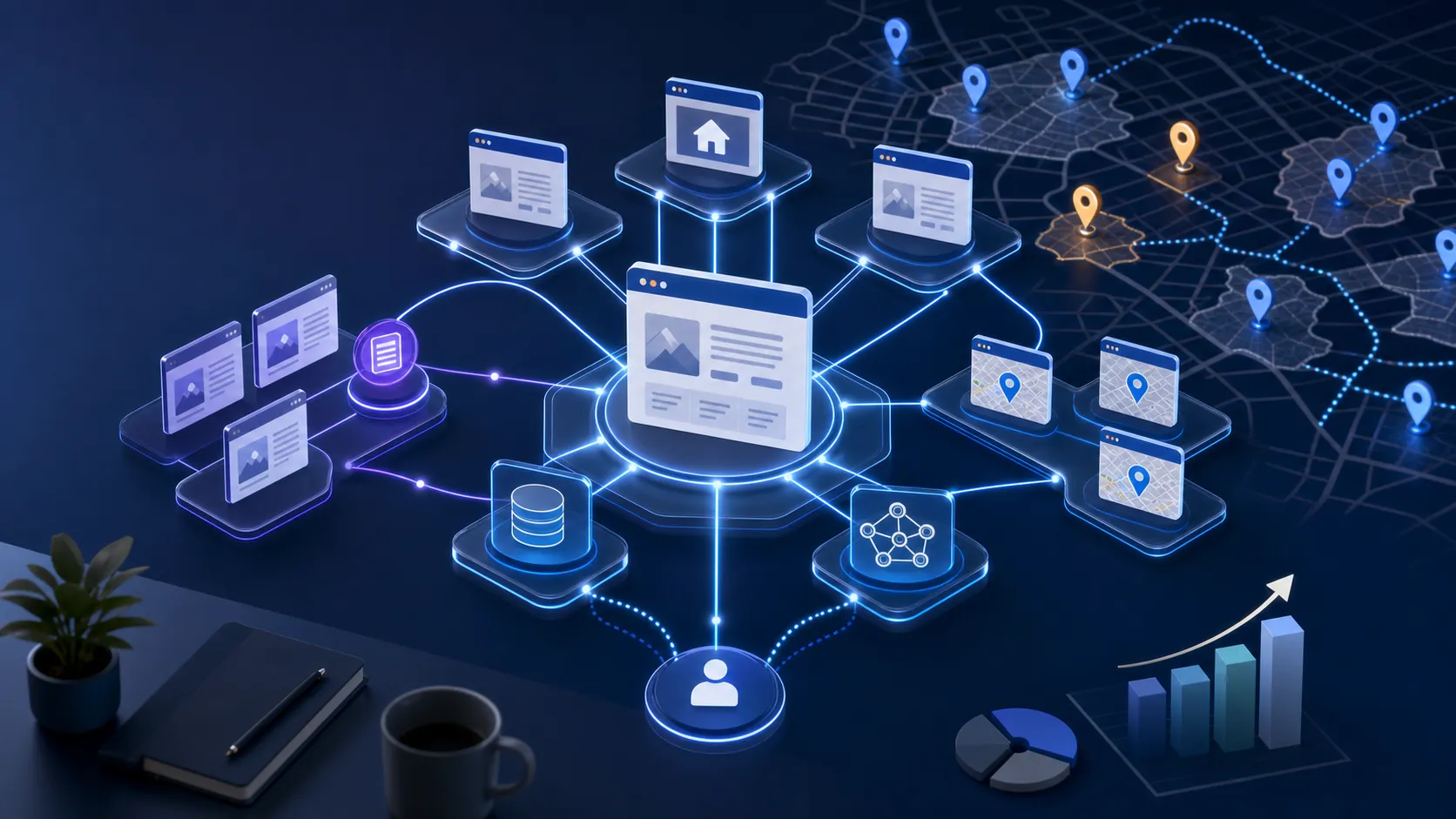
The architecture of a service business website determines how well it can capture search visibility, direct user behavior, and turn organic traffic into revenue. Backlinks matter, but internal links are the roadmap search engines, AI crawlers, and prospective clients use to understand what the business offers and where it operates.
For contractors, consultants, clinics, agencies, and local service providers, the website cannot behave like a static brochure. It needs to operate like a structured growth system. Internal links are the connective tissue of that system. They define hierarchy, distribute ranking authority, explain semantic relationships, and guide visitors from informational pages toward commercial service pages.
Quick answer: A strong internal linking strategy for local businesses uses shallow crawl depth, service hubs, location hubs, contextual blog links, descriptive anchor text, breadcrumb trails, and entity schema so Google, AI search crawlers, and human buyers can understand the relationship between services, cities, and conversion pages.
When executed well, internal linking helps a local business earn visibility across multiple nearby cities without pretending to have offices in every location. When executed poorly, it creates orphan pages, wastes crawl budget, hides high-intent landing pages, and makes the site harder for traditional SEO and Generative Engine Optimization systems to trust.
This guide explains how to diagnose internal linking issues, prioritize the fixes, build local SEO silos, use schema markup, and adapt the architecture for AI search.
What This Problem Really Means for a Business
A weak internal linking structure is not just a technical SEO problem. It is a business liability. It increases customer acquisition costs, reduces the return on content investment, and creates friction between visitor intent and conversion.
The most common financial loss comes from orphan pages. An orphan page is a live page that exists on the website but has no inbound internal links from navigation, hubs, articles, breadcrumbs, or related content. Imagine an HVAC company that publishes a detailed page for emergency commercial boiler repair but never links to it from the service hub, related blog posts, or city page. The content exists, but the website architecture treats it like it does not matter.
Search crawlers discover pages by following links. If a page only appears in a sitemap but is not connected through the site, it may be crawled less often, understood less clearly, and ranked less confidently. Human visitors also struggle because they cannot naturally move from a problem-aware article to the relevant service page.
The second business problem is conversion loss. A user who lands on an article about early warning signs of a roof leak should be one click away from the roof inspection service. A user reading about AI lead response failures should be one click away from an automation consultation. When the next logical step is buried in a menu, every extra click becomes friction.
The third problem is geographic limitation. Multi-location and service-area businesses often publish thin city pages that do not support one another. Without a clear local content architecture, search engines see disconnected pages instead of a strong geographic knowledge base. That limits visibility outside the business’s immediate physical area.
For local SEO, internal linking answers three commercial questions:
- Which pages are most important?
- Which services belong to which locations?
- Which informational content supports which conversion pages?
If the architecture does not answer those questions, Google and AI answer engines have to guess.
Why Most Businesses Get This Wrong
Most local business websites rely too heavily on default CMS navigation. A header menu and footer are useful, but they are not a complete internal linking strategy. If every page is linked the same way from a mega-menu, the site does not communicate priority, topical depth, or contextual relevance.
Generic anchor text is another major failure. Links like “click here,” “read more,” and “learn more” give crawlers almost no information about the destination page. Anchor text is a relevance signal. A link that says “commercial HVAC maintenance in Miami” gives much clearer context than a button that says “more details.”
Many sites also cross-link pages without a strategic reason. A page about commercial electrical installations should not randomly link to residential plumbing content unless there is a clear user need. Internal links should create topical clarity. Random links create noise.
The final problem is AI visibility. Many modern websites rely on client-side JavaScript for navigation, filters, route changes, or dynamic content. Google can render much of the modern web, but many AI crawlers have more limited rendering capability. If important content and internal links do not appear in the initial HTML response, AI systems may not see the architecture at all.
This is why technical SEO and GEO are now tied directly to web development decisions. A beautiful interface still needs crawlable, semantic HTML underneath it.
How to Diagnose Internal Linking Issues
Internal linking should be diagnosed with data, not only by looking at menus. The goal is to understand how a crawler sees the website.
Start with a full site crawl using a tool such as Screaming Frog SEO Spider, Sitebulb, or a comparable technical SEO crawler. The most important first metric is crawl depth, sometimes called click depth. Crawl depth measures how many clicks it takes to reach a URL from the homepage.
For a local service business, critical pages should usually be reachable within two or three clicks. That includes:
- Core service pages.
- Primary location pages.
- Local service pages where they exist.
- High-converting comparison or pricing pages.
- Important proof pages and case studies.
Pages buried five, six, or seven clicks deep receive weaker internal authority and are harder for visitors to reach. They may still be indexed, but they are structurally deprioritized.
Next, identify orphan pages. A normal crawl can only discover linked URLs, so orphan detection requires comparing multiple URL sources:
| Source | What it reveals |
|---|---|
| XML sitemap | URLs the site claims are indexable and important. |
| Google Search Console | URLs Google has discovered, indexed, or attempted to crawl. |
| Analytics | URLs that have received real visits. |
| Standard crawl | URLs reachable through internal links. |
If a URL appears in the sitemap, Search Console, or analytics but does not appear in the internal crawl, it is likely orphaned or nearly orphaned.
Then audit anchor text. Export the inbound internal links pointing to your most valuable service pages. If most anchors say “learn more,” the page is missing semantic support. If every anchor repeats the same exact keyword phrase, the profile may look manipulative. Healthy anchor text uses natural variation.
Finally, check broken links and redirect chains. Internal links should point directly to final 200 status URLs. A site that routes users through old 301 chains wastes crawl budget, slows bots, and creates unnecessary latency.
What to Fix First
Do not start by building complex silos if the current architecture is broken. Fix the highest-risk structural issues first.
1. Recover or remove orphan pages
Every orphan URL should be reviewed for value.
If the page is outdated, redundant, or no longer useful, remove it and use a 301 redirect to the closest relevant active page. If there is no relevant replacement, a 410 response may be appropriate.
If the page is valuable, reintegrate it into the architecture. Add contextual links from relevant parent pages, related articles, service hubs, location pages, and breadcrumbs. The goal is to make the page discoverable and meaningful within the site, not just present in the sitemap.
2. Reduce crawl depth for commercial pages
High-value commercial pages should not be buried. Bring them closer to the homepage through service hubs, homepage sections, footer categories, related content modules, and article links.
For example, a local SEO service page should be linked from SEO articles, technical SEO checklists, website architecture guides, and relevant location pages. A web development service page should be linked from articles about crawlability, performance, and CMS architecture.
3. Replace generic anchor text
Use descriptive anchors that explain the destination naturally. Do not force exact-match keywords everywhere. Rotate between exact, partial, semantic, and branded anchors.
Weak anchor examples:
- Click here.
- Learn more.
- Our services.
Stronger anchor examples:
- Technical SEO audits for service businesses.
- Local SEO and GEO strategy.
- AI lead response automation workflows.
4. Fix broken links and redirect chains
Internal links should point to the current canonical URL. If a blog post links to an old redirected page, update the source link. This keeps the crawl path clean and prevents avoidable authority loss.
Technical SEO Considerations
Internal links distribute authority. A simplified PageRank model looks like this:
PR(A) = (1 - d) + d * sum(PR(Ti) / C(Ti))
In plain English, the authority passed to a page depends on the authority of the linking pages and the number of outbound links on those pages. A page with hundreds of unfocused links passes less concentrated value through each individual link than a page with a smaller set of deliberate links.
This does not mean a website should avoid useful links. It means important pages need deliberate, relevant links from strong pages. A homepage should not be treated as a dumping ground for every URL. It should guide users and crawlers toward the highest-value service, location, proof, and conversion paths.
For local businesses, internal linking should also support clear URL intent. Avoid creating multiple pages that target the same keyword with slightly different wording. That creates cannibalization. Each page should have a distinct job:
| Page type | Primary role |
|---|---|
| Homepage | Brand, primary offer, trust, and route selection. |
| Service hub | Main commercial topic and service category authority. |
| Location page | Geographic relevance and local proof. |
| Local service page | Service plus location intent when enough demand exists. |
| Blog article | Informational support, problem education, and contextual links. |
| Proof page | Evidence, case study context, and conversion support. |
A good structure makes those roles obvious.
Integrating Schema Markup for Local Entities
Internal links connect URLs. Schema markup connects entities. For modern local SEO, both are needed.
A LocalBusiness schema node can define the business entity, service area, contact points, and sameAs profiles. Service schema can define the commercial offers. Article and FAQPage schema can define educational content and answer blocks. BreadcrumbList schema can define hierarchy.
The most important implementation detail is stable @id usage. If the business entity uses https://example.com/#business, service and article schema can reference that same identifier. This tells crawlers that the page, service, author, and business belong to the same entity graph.
For this website architecture, the schema strategy should align with visible internal links:
- BlogPosting schema for editorial articles.
- FAQPage schema for visible FAQ sections.
- BreadcrumbList schema for page hierarchy.
- LocalBusiness or ProfessionalService schema for the business entity.
- Service schema for the core offer pages.
- ImageObject schema for important article and service images where available.
This is especially important for AI answer engines. A crawler may parse the internal links, but schema reduces ambiguity by making the relationships explicit.
Designing Local SEO Silos
A local SEO silo is a controlled group of pages focused on a service area, service category, or both. The goal is not to create thin city pages. The goal is to build a useful, interconnected cluster that proves the business understands a specific market and service intent.
There are two common models.
| Model | Example | Best use |
|---|---|---|
| Physical silo | /miami/ac-repair/ |
Large sites with many location-service combinations. |
| Virtual silo | Separate flatter URLs linked by strict rules | Smaller sites that want clean URLs and less routing complexity. |
Both models can work. The deciding factor is whether the website can support the content quality required for every URL. A city-service page should not exist just because a keyword exists. It should have unique local context, proof, FAQs, service details, and a reason to be indexed.
Local SEO pillar-and-cluster architecture

The practical linking rules are simple.
- Every local service page links upward to the main city or service-area pillar.
- The city pillar links downward to every justified local service page.
- Closely related service pages link laterally when the user intent overlaps.
- Informational articles link downward to commercial pages with descriptive anchor text.
- Conversion pages are reachable from the commercial pages without forcing menu hunting.
This structure turns isolated pages into a cluster. Over time, the cluster can become a recognizable knowledge base for that market.
Internal Linking for AI Search and GEO
AI crawlers need architecture that is easy to retrieve, parse, and quote. That means internal linking now affects more than standard search rankings. It affects how likely a site is to be understood by AI Overviews, ChatGPT-connected search, Perplexity, Claude-based crawlers, and other answer systems.
Many AI crawlers have limited JavaScript rendering. They may fetch the raw HTML, extract links, parse headings, read schema, and leave. If the navigation depends on hydration or hidden client-side state, the crawler may miss important relationships.
For AI visibility, prioritize:
- Server-rendered or statically generated core content.
- Semantic HTML with clear
nav,main,article, and heading hierarchy. - HTML links for critical navigation and contextual CTAs.
- Visible FAQs that match FAQ schema.
- Breadcrumbs that match BreadcrumbList schema.
- Descriptive anchor text near relevant supporting paragraphs.
A well-linked site gives AI systems a retrieval map. If an article about crawl depth links to a service page about SEO growth systems, and that service page links to proof, FAQs, and booking, the AI system can understand the commercial path instead of treating each URL as a disconnected document.
Strategic Execution for Service Businesses
Start with one priority market or service category. Trying to build ten geographic silos at once usually creates low-quality pages and weak links. Pick the city or service area with the strongest commercial opportunity, then build it properly.
A practical execution sequence looks like this:
- Choose the target market based on real service capacity and search demand.
- Map primary commercial terms, service-specific terms, and informational questions.
- Assign every intent to a specific URL before writing content.
- Build or improve the city pillar page.
- Build only the local service pages that can be supported with unique value.
- Publish informational articles that answer real buyer questions.
- Link articles to the correct commercial pages using descriptive anchors.
- Add breadcrumbs, schema, and related-content modules.
- Crawl the site again and verify depth, inlinks, anchors, and 200 status paths.
- Monitor Google Search Console to see whether impressions and crawled pages improve.
For businesses that depend on speed-to-lead, connect the internal linking strategy with AI lead response automation. A page that ranks but does not route leads quickly is still leaking revenue.
Mistakes to Avoid
The first mistake is cross-silo linking without context. A Miami HVAC silo and a Fort Lauderdale plumbing silo should not link to each other just because both pages need links. Cross-links should serve the user and preserve topical clarity.
The second mistake is duplicate city content. Do not copy one service page, swap the city name, and publish it repeatedly. That creates thin content and weak trust. Local pages need unique proof, context, FAQs, examples, and service details.
The third mistake is anchor text over-optimization. Descriptive anchors are good. Repeating the same exact phrase dozens of times is not. Use natural variations that fit the sentence.
The fourth mistake is ignoring off-site entity consistency. Your Google Business Profile, citations, social profiles, and website location pages should agree. If the website says one thing and external profiles say another, AI systems and search engines receive mixed signals.
The fifth mistake is relying only on XML sitemaps. Sitemaps help discovery, but they are not a substitute for internal links. A page listed in the sitemap but absent from the visible architecture is still structurally weak.
Practical Checklist
| Phase | Action item | Objective | Priority |
|---|---|---|---|
| Diagnostic audit | Crawl the site and export crawl depth, internal inlinks, status codes, and anchor text. | Map the current architecture. | Critical |
| Diagnostic audit | Compare crawl data with XML sitemaps, Search Console, and analytics. | Identify orphan pages. | Critical |
| Technical cleanup | Fix broken internal links and update redirected internal links at the source. | Preserve crawl budget and user trust. | High |
| Architecture | Define service hubs, location hubs, and justified local service pages. | Prevent cannibalization and thin pages. | Critical |
| Content | Map each keyword intent to one primary URL. | Clarify which page should rank. | High |
| Internal links | Add contextual links from articles to commercial service pages. | Move informational visitors toward conversion. | High |
| Local silos | Link city pillars, local service pages, and supporting articles with clear rules. | Build geographic topical authority. | High |
| Entity SEO | Implement LocalBusiness, Service, Article, FAQPage, and BreadcrumbList schema where appropriate. | Make relationships machine-readable. | Critical |
| AI readiness | Keep critical content and links in the initial HTML. | Improve accessibility for JavaScript-limited AI crawlers. | Critical |
| Conversion | Route high-intent pages to contact, booking, chatbot, or CRM workflows. | Turn ranking visibility into qualified leads. | High |
Final Recommendation
Internal linking is not a secondary SEO tactic. It is the architectural framework that tells search engines, AI systems, and buyers how the business is organized.
For local businesses, the strongest structure is simple to describe but disciplined to execute: shallow important pages, clear service hubs, local relevance, contextual links from articles, schema-backed entity relationships, and conversion paths that do not make users work.
A local business that fixes orphan pages, improves crawl depth, builds real service and location clusters, and connects content to lead capture will usually have a stronger foundation than competitors relying only on backlinks or generic city pages.
For help building this kind of search-ready architecture, review the SEO growth service, explore website development, or schedule a consultation through the booking page.
Works Cited
- Simple Internal Linking Strategies to Boost Local SEO
- Internal Linking Best Practices for Enterprise Local Brands
- Internal Links SEO Best Practices
- Local SEO Silos: How to Rank in Multiple Cities Without Multiple Locations
- Tech SEO in GEO: Why Your Technical Setup Is Essential for LLM Visibility
- Internal Linking for SEO: Complete Strategy Guide
- Orphan Pages: What They Are and How to Find and Fix Them
- Silo Site Structure: Or How Not to Waste Your SEO Budget
- Why Content Silos Help Google Understand Your Website
- Screaming Frog SEO Spider Website Crawler
- Internal Linking Audit With the SEO Spider
- How To Find Orphan Pages
- Local Schema Markup: Structured Data for Local Search
- Using Local Business Schema and JSON-LD Markup for SEO
- LocalBusiness Schema JSON-LD Guide and Examples
- Schema Markup for a Local Business Service Page Using JSON-LD
- SEO Silo Structure: A Practitioner’s Guide
- Multi-Location SEO: Guide to Ranking Multiple Business Locations
- A Complete Guide to Local SEO for Multiple Locations
- What is Silo Structure in SEO?
- What is an SEO Silo Structure and How to Implement One