
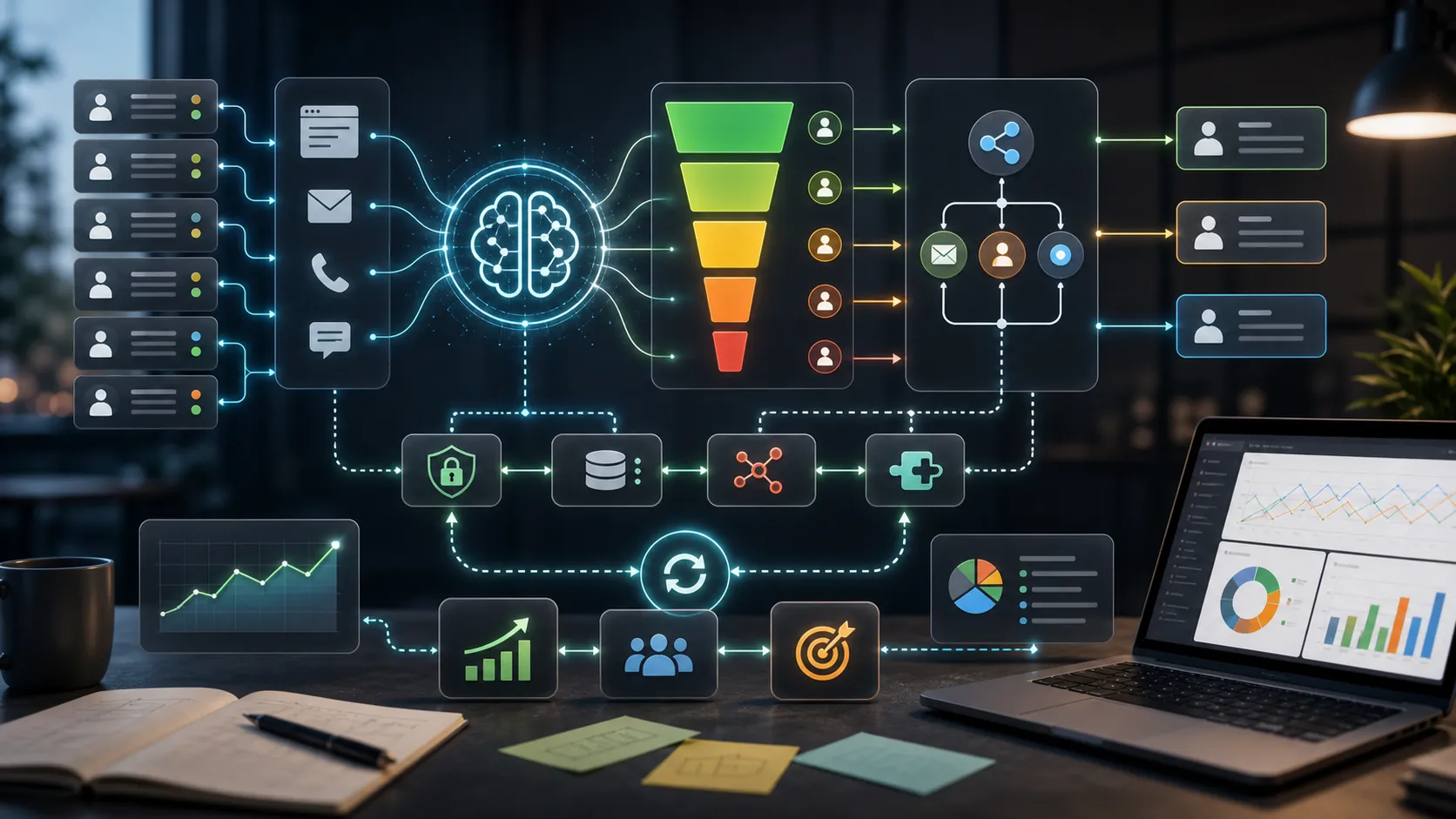
Lead qualification has moved from manual sorting to automated revenue operations. The old process depended on sales representatives reviewing every form submission, checking public profiles, guessing fit, and deciding who deserved fast follow-up. That process creates pipeline leakage because response speed matters. A lead contacted within five minutes of an inquiry is far more likely to enter a sales cycle than a lead contacted after a delayed manual review.
The modern challenge is usually not lead volume. Digital marketing, paid search, local SEO, and content campaigns can generate steady inbound demand. The failure point is qualification speed and accuracy. Manual scoring rules, disconnected tools, and inconsistent follow-up let high-intent buyers go cold while sales teams spend time on prospects that were never a fit.
AI lead qualification changes the operating model. Instead of reactive sorting, the business can use predictive scoring, automated enrichment, conversational intake, CRM workflows, and ad-platform feedback loops to qualify prospects in seconds. Done correctly, AI does not replace sales judgment. It removes repetitive work, exposes better context, and gives humans more time with the right opportunities.
The Core Architecture of AI-Driven Qualification
AI does not replace foundational marketing strategy. It multiplies the speed and consistency of the operating system behind that strategy. A strong AI qualification system has three interconnected pillars:
- Predictive lead scoring.
- Automated data enrichment.
- Real-time conversational routing.
These systems work together to identify who the prospect is, what they need, how likely they are to buy, and what should happen next.
Predictive Lead Scoring Models
Traditional lead scoring often uses static rules. A prospect might get points for opening an email, visiting a pricing page, downloading a guide, or selecting a certain company size on a form. Static rules are useful as a starting point, but they are limited because they reflect human assumptions instead of live conversion patterns.
Predictive lead scoring uses machine learning to analyze historical conversion data. The model can ingest firmographics, behavior, source, engagement patterns, CRM outcomes, sales notes, and closed-won data. It then assigns a dynamic probability score to each new inquiry.
The value is in micro-signals. A prospect who repeatedly visits a technical service page, compares implementation content, downloads documentation, and returns from a branded search may be showing stronger buying intent than a prospect who fills out a generic form once. AI can weight those patterns based on what has actually preceded closed revenue in the business’s CRM.
| Metric Category | Traditional Manual Processing | AI-Automated Processing | Operational Impact |
|---|---|---|---|
| Response time | Hours to days | Under 5 minutes | Faster follow-up protects high-intent demand. |
| MQL-to-SQL rate | Often inconsistent | Higher when trained on real conversion data | Reduces pipeline leakage and wasted sales effort. |
| Data enrichment | Manual LinkedIn and Google research | Real-time API extraction | Reps enter calls with better context. |
| Availability | Standard business hours | Continuous 24/7 coverage | Captures after-hours, weekend, and multilingual demand. |
Automated Data Enrichment and Signal Detection
AI qualification improves when the system has enough context. A strong workflow enriches the lead record immediately after capture. It can append company size, industry, technology stack, recent funding, location, website information, executive changes, and verified contact details.
This matters because forms are incomplete by nature. A qualified enterprise buyer may use a generic email address. A high-value local service lead may leave a short message because they are in a hurry. A prospect may submit a request after hours when no human is available. Enrichment gives the scoring model context before a rep touches the record.
Some systems also use website visitor identification and account-level intent signals before a form submission happens. This can trigger targeted chat, alerts, or account research when a valuable company is engaging with important pages.
Real-Time Routing and Conversational Engagement
Lead capture and assessment should be immediate. AI chatbots, AI SDR agents, and voice agents can answer initial questions, gather qualification data, and route prospects while intent is still active.
Effective conversational qualification should ask only the questions that matter. It should avoid long interrogations, maintain a natural brand-aligned tone, filter spam or low-fit inquiries, and escalate quickly when a high-intent prospect is detected.
For example, a strong website chatbot might ask:
- What outcome are you trying to achieve?
- What is your timeline?
- What system or website do you already use?
Those three answers can be enough to score urgency, fit, service category, and routing priority.
Revolutionizing Integration with Model Context Protocol
One of the most important advances in AI automation is the Model Context Protocol, often shortened to MCP. Large language models were historically isolated from live business systems. They could reason over prompts, but they could not reliably access a CRM, inspect current records, call internal tools, or update operational systems without brittle custom integrations.
MCP solves that problem by creating a standardized communication layer between AI systems and external tools. It lets AI securely discover available capabilities, retrieve authorized context, and execute approved actions across connected systems.
For lead qualification, Model Context Protocol integration turns an AI assistant from a passive adviser into an operational agent that can work with live sales data.
The Technical Architecture of MCP
MCP uses a client-server structure that separates reasoning from data access and tool execution.
- MCP Host: The AI application where the user interacts with the model. This might be a chatbot, an AI-powered workspace, an integrated development environment, or an enterprise platform.
- MCP Client: The translator inside the host. It sends structured requests to approved MCP servers and returns the results in a format the AI model can use.
- MCP Server: The external service that exposes data or tools. A server might connect to a CRM, SQL database, analytics system, file repository, lead enrichment platform, or internal API.
- Transport Layer: The communication layer that moves structured messages between the client and server, commonly using JSON-RPC patterns and secure local or remote transports.

| MCP Primitive | Description | AI Lead Qualification Application |
|---|---|---|
| Resources | Contextual read-only data the AI can reference securely. | AI reads CRM notes, website engagement history, and account context before scoring a lead. |
| Tools | Executable functions or APIs that allow the AI to take action. | AI updates lead status, creates a task, routes an owner, or books a meeting. |
| Prompts | Predefined templates or workflows guiding the AI’s behavior. | AI runs a lead-scoring prompt that evaluates urgency and fit against the ICP. |
MCP Use Cases for Sales and Lead Qualification
MCP is especially useful for revenue operations because lead qualification depends on live context from multiple systems.
Cross-platform workflow execution: An AI assistant can retrieve a lead summary, analyze fit, qualify the lead into an opportunity, generate a personalized email, and update the CRM record through standardized tool calls.
Instantaneous data enrichment: An AI assistant can request prospect data from a data platform, compile an account brief, verify contact information, and present firmographic context before outreach.
Signal-based lead routing: When a relevant business signal appears, such as funding, expansion, hiring, a technology migration, or repeated engagement with a high-intent page, the AI can update CRM fields, trigger assignment logic, and notify the right sales channel.
Enterprise security and governance: MCP can be designed around authorization, scoped permissions, and approved tool access. The AI should only reach systems and records the business has explicitly permitted.
Orchestrating Automated Workflows with n8n
MCP provides a standardized bridge between AI and business tools. Workflow automation platforms such as n8n provide the step-by-step orchestration for capture, scoring, routing, notifications, and data logging.
A resilient AI-powered lead qualification workflow in n8n usually follows this sequence:
- Lead capture via webhook: A new lead submits a form, replies to a campaign, books a call, or sends an inbound email. n8n captures the raw payload with details such as name, email, company, source, service interest, and message.
- AI analysis and context extraction: The workflow sends the raw data to an AI model with a structured prompt. The model extracts business intent, urgency, fit, objections, service category, and missing information. It returns structured JSON with a score and label such as
High-Intent Enterprise,Qualified Local Service Lead,Nurture, orSpam. - CRM integration and data logging: The scored lead is written to HubSpot, Salesforce, Airtable, Pipedrive, or another CRM. The workflow appends the AI’s reasoning as an internal note so the sales team can see why the score was assigned.
- Conditional logic and routing: A switch node evaluates the score. Hot leads trigger Slack, Teams, SMS, calendar, or owner-assignment actions. Lower-score leads enter nurture sequences instead of consuming immediate human attention.

Closing the Growth Loop with Offline Conversion Tracking
Automating qualification is only half of the growth system. The next step is using qualified-lead and closed-revenue data to train advertising platforms to find better prospects.
Many Google Ads campaigns optimize for top-of-funnel events such as form submissions. That can cause the platform to chase the cheapest possible form fills instead of the most valuable customers. The result is more spam, more low-intent leads, and more wasted sales time.
Offline conversion tracking fixes this by feeding CRM outcomes back into the ad platform. Instead of optimizing only for form submissions, the system can optimize for qualified leads, opportunities, signed contracts, closed deals, or revenue value.

Qualified Leads vs. Converted Leads
Google Ads supports deeper lead-funnel measurement through offline events.
Qualified leads are leads that came from Google Ads and were later vetted, scored, or approved in the CRM.
Converted leads are leads that completed a final business outcome, such as a signed contract, paid invoice, booked project, or closed sale.
This distinction helps the ad platform understand the difference between easy form volume and actual business value.
GCLID vs. Enhanced Conversions for Leads
There are two primary approaches to offline conversion tracking.
| Tracking Method | Core Mechanism | Primary Advantage | Limitation |
|---|---|---|---|
| GCLID import | Captures the Google Click Identifier from the ad URL and stores it with the lead record. | Strong for linear, single-device journeys. | Can fail if cookies are cleared or the journey moves across devices. |
| Enhanced Conversions for Leads | Hashes first-party data such as email or phone at submission and uses it for matching later. | Better cross-device attribution and stronger resilience to privacy changes. | Requires strict privacy compliance and careful data handling. |
| Dual implementation | Sends both GCLID and hashed first-party data. | Highest redundancy and match reliability. | Requires deeper CRM and webhook integration. |
For advanced revenue operations, a dual approach is often the strongest setup. If the click identifier is lost, hashed first-party data may still allow the platform to match the offline conversion.
Sector-Specific Implementations in Florida Markets
AI lead qualification is not one-size-fits-all. It has to adapt to the sales cycle, buyer risk, urgency, language needs, and local market dynamics.
Real Estate in South Florida
South Florida real estate depends on fast response and careful filtering. Buyers may browse online listings for weeks before contacting an agent, and listing agents often lack context until a direct inquiry arrives.
AI changes that by analyzing property-page engagement, source, browsing depth, neighborhood interest, timeline, budget, financing status, and repeat visits. The system can ask targeted questions about geographic preference, buying timeline, pre-approval, and budget range.
A serious buyer with pre-approval, relocation pressure, and repeated activity in the same neighborhood should be routed differently than a casual browser whose stated budget does not match the inventory they are requesting.
Legal Services and Law Firms
Small and mid-sized law firms often lose time on intake administration. AI-powered intake can answer preliminary questions, schedule consultations, collect basic case details, and filter inquiries that fall outside the firm’s practice areas.
For Miami law firms, bilingual intake and fast response are especially important. AI can help smaller firms compete on responsiveness without increasing administrative headcount.
Home Services, HVAC, Plumbing, and Construction
For Florida home services, a missed emergency call can mean a lost job. AI answering systems can qualify severity, service location, timeline, and job type.
If the caller describes a burst pipe, severe leak, or air-conditioning failure during peak heat, the system can bypass ordinary scheduling and route the call to an on-call technician. Routine inquiries can receive service-area confirmation, basic pricing guidance, and direct booking.
Multilingual Lead Qualification
In South Florida and in global B2B markets, English-only automation can cap growth. Strong multilingual AI agents do not simply translate the output of an English-only system. They detect language automatically, reason over the inquiry, and respond in the user’s preferred language.
Native language generation is different from a translation layer. A translation layer can add latency, miss cultural nuance, mistranslate industry terminology, and struggle with code-switched language. Native multilingual systems can handle English-Spanish switching more naturally, which matters in Miami, Hialeah, and other bilingual markets.

| Model | Core Architecture | Primary Strength | Best Use Case |
|---|---|---|---|
| Qwen3-235B-A22B | Mixture-of-Experts architecture | Native-level fluency across many languages and strong reasoning modes | Enterprise multilingual reasoning and complex logic. |
| Meta-Llama-3.1-8B-Instruct | Instruction-tuned 8B model | Strong price-to-performance ratio for dialogue | High-volume Spanish chatbots and conversational agents. |
| Qwen3-14B | Mid-sized multilingual model | Balance between efficiency and reasoning | Mid-tier applications requiring fast dialogue and backend logic. |
For custom AI infrastructure, model choice should be tied to the language mix, latency target, budget, privacy needs, and complexity of the workflow.
Strategic Implementation Framework
AI lead qualification should be deployed as a phased system, not a pile of disconnected tools.
- Define the ICP and audience data: Use CRM data and analytics to define pain points, budget range, company size, industry fit, buying signals, and online behavior.
- Select the right stack incrementally: Start with one or two tools that solve the biggest bottleneck. That may be CRM scoring, n8n routing, a conversational AI agent, or offline conversion tracking.
- Automate the capture phase: Use intelligent forms, AI chat, voice agents, and webhooks to collect data instantly.
- Implement predictive scoring and routing: Score intent and fit, then use CRM rules to route high-priority leads to humans fast.
- Establish AI nurturing sequences: For leads that are qualified but not ready, trigger personalized follow-up based on interests and buying stage.
- Analyze, feed back, and optimize: Measure MQL-to-SQL rate, false positives, response speed, and closed revenue. Feed that data back into the scoring model and ad platforms.
Common Mistakes to Avoid
Chasing volume over quality: Lead volume is a vanity metric if it does not produce qualified opportunities. Optimize for revenue outcomes, not raw form fills.
Over-automating sales conversations: Prospects should have a clear path to a human when they show high intent or frustration. AI should know when to step aside.
Feeding AI poor or fragmented data: Duplicate CRM records, outdated fields, and inconsistent sales notes create flawed scoring. Data cleanup is part of the AI project.
Ignoring the landing page experience: AI can route, score, and optimize traffic, but weak pages still fail. Landing pages need clear answers, proof, trust signals, and conversion paths.
Strategic Decision Matrix
The right approach depends on technical maturity, sales complexity, and budget.
When to optimize: If the business already generates leads but suffers from poor conversion quality or wasted ad spend, start by improving tracking, CRM hygiene, offline conversion data, and Smart Bidding signals.
When to automate: If the business spends too many manual hours reviewing inquiries, answering repetitive questions, or missing the five-minute response window, implement workflow automation, AI scoring, and conversational intake.
When to build: If the organization has strict security requirements, proprietary systems, unusual data models, or complex cross-functional operations, build custom infrastructure around MCP, internal APIs, and controlled tool access.
For local businesses, service businesses, startups, and B2B teams, the practical goal is a unified system: lead capture, AI scoring, CRM updates, human handoff, nurture, and ad-platform feedback all working together.
Conclusion
AI lead qualification is a shift in how revenue operations are built. Businesses can no longer afford pipeline leakage caused by delayed response times, manual data entry, and intuition-based prioritization.
Predictive scoring, conversational AI, automated routing, CRM enrichment, and offline conversion tracking create a faster and more accurate qualification system. MCP adds another layer by connecting AI reasoning to real business tools and live operational context.
When qualified-lead data is fed back into advertising platforms, the system becomes a self-improving growth loop. Marketing learns which prospects are valuable. Sales gets better context faster. Operations spends less time on repetitive work.
For teams that need this system built correctly, the work should connect AI workflow automation, Model Context Protocol integration, Google Ads management, and a clear contact path into one practical implementation.
Works Cited
- Future of Automated Lead Qualification with AI & Humans - B2B Rocket
- Best AI Tools for Inbound Lead Qualification (2026) - Autobound.ai
- AI Lead Generation Fundamentals: Complete Guide 2026 - Jeeva AI
- How to Use AI for Lead Generation in 2026 (A Practical, No-Hype Guide) - The AI Publisher
- AI for Real Estate: Automate Lead Qualification and Follow-Up - MindStudio
- 5 MCP use cases every sales team should try with Lusha
- How to Use AI for Lead Generation in 2026 (Complete Guide) - Concept Beans
- Model Context Protocol: What Is MCP for Generative AI? - Salesforce
- What is Model Context Protocol (MCP)? A guide - Google Cloud
- Model Context Protocol (MCP) explained: how AI connects to your real work - Monday.com
- Connect AI agents to sales workflows using Model Context Protocol server - Microsoft Learn
- AI-Powered Lead Qualification and Routing with OpenAI, Slack, and Airtable - n8n
- Offline Conversion Tracking: The Complete Guide for PPC Advertisers - ALM Corp
- About qualified leads and converted leads - Google Ads Help
- How to Set Up Conversion Tracking Google Ads with AI (2026) - Ryze AI
- Set up offline conversions using Google Click ID (GCLID) - Google Ads Help
- Infinityy - MIAMI REALTORS
- Real Estate Lead Qualification 2026: AI Phone Screening - NextPhone
- 6 Best AI Answering Services for Contractors in 2026 - LeadTruffle
- Best Multilingual AI Agents for Customer Service in 2026 - Fin AI
- Ultimate Guide: The Best Open Source LLM for Spanish in 2026 - SiliconFlow
- Multilingual Prompts in LLM-Based Recommenders: Performance Across Languages - arXiv